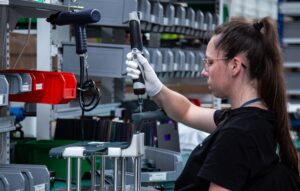
Are you thinking about assembly outsourcing, but not sure how to do it right?
Outsourcing assembly can significantly improve efficiency and profitability – if approached strategically. While almost any process can be outsourced, selecting the right products is essential to achieve the best results. To help you make this decision, we’ve prepared key insights based on our experience as a precision assembly and contract manufacturing partner for European companies.
For many small and medium-sized manufacturers, assembly outsourcing is not just about cost reduction. It’s about improving scalability, speeding up time-to-market, and focusing internal resources on core competencies. A well-chosen outsourcing strategy can completely transform the way your production operates.
Step 1 – Review your product portfolio:
Start by identifying products that consume significant labour, involve repetitive operations, or require specialized assembly skills. These products benefit most from outsourcing.
For example, mechanical assemblies with multiple components in BOM, or electro-mechanical modules that require precision wiring, soldering, or testing, are ideal candidates.
However, products that are highly proprietary, complex, or involve sensitive intellectual property may require detailed evaluation before being outsourced.
Step 2 – Assess production volumes and frequency:
Products with high-mix and low-volume characteristics or those produced seasonally can put strain on internal capacity. Outsourcing such assemblies helps maintain flexibility without heavy investment in machinery or personnel.
At the same time, very low-volume prototypes or projects with frequent design changes may still be more efficient to keep in-house.
Step 3 – Ensure quality and process control:
Quality standards must remain uncompromised. Choose a partner capable of matching or exceeding your internal quality level.
Look for ISO-certified companies with proven experience in precision mechanical and electromechanical assembly, functional testing, and final inspection.
A reliable partner should also manage sensitive components such as ESD-protected electronics, ensuring safety and performance throughout the process.
Step 4 – Evaluate cost and supply chain benefits:
Outsourcing to a nearshore manufacturing partner can simplify logistics, reduce lead times, and strengthen supply chain resilience.
Products with high labour content or complex sourcing requirements benefit most from partners who can leverage local supplier networks and optimize procurement.
Compare not only production costs but also hidden benefits such as reduced inventory, faster response to demand fluctuations, and improved delivery reliability.
Don’t leave your outsourcing decisions to chance. Contact our team today to discuss which of your products could benefit most from precision-driven nearshore assembly.

IMA Technik at Industrial Spring 2026 in Kielce
As a company based in Kielce, IMA Technik could not miss Industrial Spring 2026 at Targi Kielce – one of the most important industrial trade